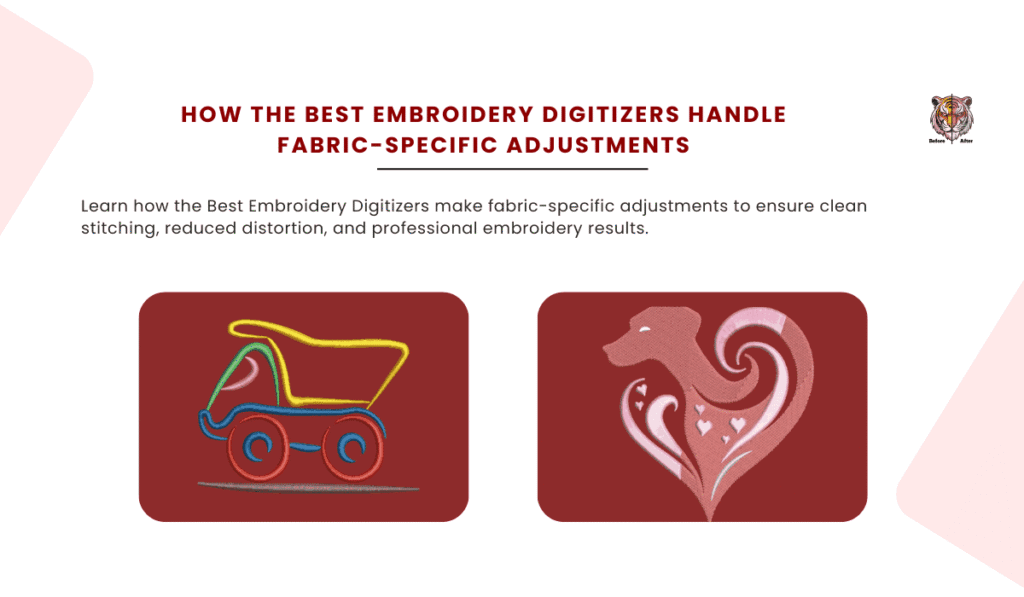
Fabric behavior plays a major role in embroidery quality. Best Embroidery Digitizers: understand that every material reacts differently under needle penetration, thread tension, and stitch density. In the middle of commercial production, fabric-specific adjustments are essential to prevent distortion, puckering, and uneven stitching.
Professional digitizers do not use a single default setting. Instead, they carefully modify stitch parameters according to fabric type, structure, and stretch level.
Understanding Fabric Characteristics Before Digitizing
Before creating a stitch file, experienced digitizers evaluate:
- Fabric thickness
- Surface texture
- Stretch percentage
- Stability and backing requirements
This initial assessment helps determine proper stitch type, density, and underlay support.
Adjusting Stitch Density Based on Fabric Type
Different fabrics require different density levels:
- Lightweight fabrics need reduced density to prevent puckering.
- Heavy materials can handle slightly higher density without distortion.
- Stretch fabrics require balanced density to maintain flexibility.
The Best Embroidery Digitizers carefully calibrate stitch density to match the material’s tolerance.
Custom Underlay for Stability
Underlay provides structure beneath the top stitches. Fabric-specific underlay adjustments include:
- Edge run underlay for clean borders on stable fabrics
- Zigzag underlay for supporting satin columns
- Tatami underlay for large fill areas
- Additional stabilization for stretchy materials
Proper underlay prevents fabric shifting during stitching.
Managing Pull Compensation
When stitches are applied, fabric tends to pull inward. Skilled digitizers adjust pull compensation to:
- Maintain accurate design dimensions
- Prevent gaps between outlines and fills
- Preserve shape consistency
This adjustment is especially important for detailed logos and small text.
Stitch Angle and Direction Control
Changing stitch angles helps distribute tension evenly across fabric. Professional digitizers:
- Alternate fill stitch directions
- Adjust satin column angles
- Reduce stress on stretch materials
These refinements improve both durability and visual quality.
Special Adjustments for Caps and Structured Garments
Caps require unique digitizing techniques due to their curved surface and central seam. The Best Embroidery Digitizers:
- Simplify excessive detail
- Reduce density in small areas
- Apply stronger underlay support
- Plan center-out stitching sequences
These methods prevent misalignment and registration issues.
Handling Delicate and Performance Fabrics
Performance wear and delicate fabrics demand extra care. Professionals:
- Lower stitch density
- Use lighter underlay
- Adjust stitch length
- Prevent needle damage
These steps preserve fabric integrity while maintaining design clarity.
Testing and Quality Control
Fabric-specific digitizing does not rely on theory alone. Skilled digitizers:
- Review stitch simulations
- Test sew-out samples when necessary
- Refine settings after evaluation
Testing ensures that the file performs accurately in real production conditions.
Long-Term Production Benefits
Fabric-optimized digitizing leads to:
- Reduced thread breaks
- Fewer rejected garments
- Better design consistency
- Improved machine performance
Over time, these advantages increase operational efficiency and customer satisfaction.
Conclusion
The Best Embroidery Digitizers handle fabric-specific adjustments through careful analysis, precise density control, customized underlay, and accurate pull compensation. Their technical knowledge ensures that each design is optimized for the material it will be stitched on. By tailoring stitch files to fabric characteristics, they prevent common embroidery issues and deliver consistent, professional results.
For embroidery businesses seeking reliable quality across multiple garment types, fabric-specific digitizing expertise is essential.
FAQs
1. Why are fabric-specific adjustments important in digitizing?
Different fabrics react differently to stitches, requiring customized density and underlay settings.
2. How do professionals prevent puckering?
They reduce stitch density, apply proper underlay, and adjust pull compensation.
3. Are cap designs digitized differently?
Yes, caps require center-out stitching and stronger stabilization techniques.
4. What happens if density is too high for lightweight fabric?
It can cause puckering, thread breaks, and fabric damage.
5. Do professional digitizers test their files?
Yes, quality professionals often perform stitch simulations and test sew-outs for accuracy.