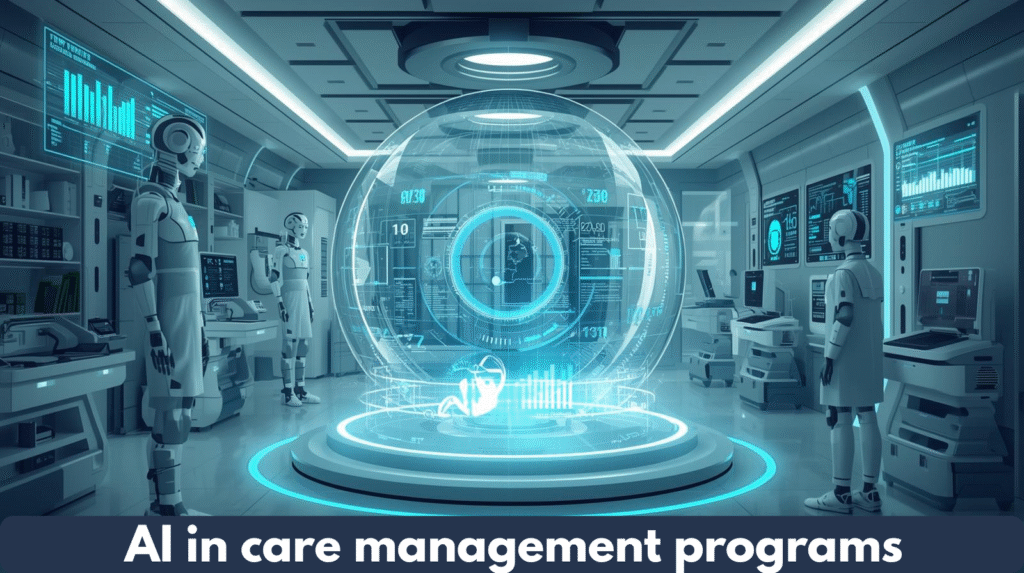
The healthcare sector is undergoing a significant transformation, with artificial intelligence playing a central role. AI in care management programs is not merely a buzzword; it is transforming the manner in which providers offer care, manage groups of patients, and enhance health outcomes. AI is helping care management become smarter, faster, and more personalized, starting with predictive health risks prior to their intensifying and continuing onward with automating the tedious administrative processes.
Why is this transition important? Traditional care management suffers from delayed interventions, fragmented data, and overburdened staff. The AI transforms that equation by looking through huge amounts of data in real-time and identifying at-risk patients immediately, and then designing extended care journeys that work. Hospital readmissions decrease, patient engagement improves, and organizations report significant cost savings.
What Does AI in Care Management Actually Mean?
AI in care management is the application of machine learning algorithms, predictive analytics, and automation applications to enhance the way healthcare teams follow, treat, and assist patients throughout their care journey. Rather than conducting a manual review and reacting to an event, AI systems analyze clinical data, claim data, and social determinants of health to provide proactive care.
How AI Processes Patient Data
AI engines analyze patient information continuously to spot patterns that indicate health risks. The system reviews:
- Clinical history and current diagnoses
- Medication adherence patterns
- Lab results and vital signs
- Social determinants affecting health outcomes
Care managers receive real-time analytics that can provide them with prioritization of cases, resource allocation, and intervention of cases that lead to minor issues to major health problems.
The Core Benefits AI Brings to Care Management
Proactive Health Monitoring That Actually Works
AI constantly analyzes patient data to identify early warning signs of chronic disorders, such as diabetes, heart disease, or COPD. In cases where trends show declining health, the system notifies care teams in real-time.
This proactive approach means:
- Earlier interventions that prevent complications
- Reduced emergency room visits
- Better long-term health outcomes for patients
- Lower overall healthcare costs
The conventional monitoring is based on planned check-ins and manual review of charts. AI works 24 hours and identifies problems that the human eye may overlook.
Personalized Care Plans Based on Real Data
Every patient is different. AI systems generate tailored care pathways based on patient history, current conditions, medications, and lifestyle factors.
Care management programs powered by AI can:
- Adjust treatment recommendations as patient conditions change
- Identify which interventions work best for specific patient profiles
- Reduce trial-and-error in treatment planning
- Improve patient adherence to care plans
Personalization drives measurable improvements in patient satisfaction and clinical outcomes.
Streamlined Administrative Workflows
Care managers waste a lot of time with paperwork rather than attending to patients. AI automates the process of updating patient records, booking appointments, prior approvals, and referrals. This automation liberates the care teams so that they can be able to concentrate on the areas that are more important, which entails building relationships with the patients and providing quality care.
Reduced Hospital Readmissions
The hospital’s maximum risk of readmission is determined through review of past hospitalization history, pharmaceutical compliance, social support, and comorbidity. With such insights, the care teams can institute specific post-discharge interventions, make timely follow-ups, and offer resources that keep the patients healthy at home.
How AI Transforms Different Aspects of Care Management
AI in care management programs not only enhances the care continuum; it sharpens the whole care continuum. AI has introduced efficiencies and insights that previously were unknown to risk stratification AI Workflow Automation Microsoft 365, care coordination, and population health management.
Risk Stratification Gets Smarter
Risk stratification involves grouping patients according to their health risks to help in prioritising the care resources. AI transforms it by computing hundreds of data points on a patient in real-time and updating risk scores in real-time as a patient changes conditions, and finding non-obvious risk factors that traditional models cannot.
Rather than using simple criteria, such as age or the diagnosis codes, AI takes into account the entire patient image medications, lab findings, behavioral health factors, and even social determinants.
Care Coordination Becomes Seamless
Healthcare deals with various providers, specialists, facilities, and services. The process of coordinating all these moving parts is traditionally known as a source of communication gaps and repeated efforts.
AI-powered digital health platforms centralize information and facilitate coordination by:
- Aggregating data from all care touchpoints
- Flagging gaps in care delivery
- Automating care team notifications
- Tracking patient journeys across settings
When everyone works from the same real-time information, patients receive more coherent, effective care.
Population Health Management at Scale
To effectively handle whole groups of patients, it is essential to know trends, those groups with high needs, and to allocate resources in a way that is strategic way. AI supports population health management by grouping patients based on clinical and social variables, anticipating future needs, and monitoring outcomes across populations. Healthcare organizations will be able to change their responsive approach to proactive health management that enhances the outcomes of the whole population.
Real-World Impact: What Organizations Are Seeing
Healthcare organizations implementing AI in care management report tangible improvements across multiple metrics. Patient outcomes improve with fewer emergency department visits, reduced complications from chronic conditions, higher medication adherence rates, and improved quality of life scores.
Operational efficiency increases as care managers handle larger patient panels effectively, high-risk patients are identified faster, administrative overhead decreases, and resource allocation improves. Financial performance strengthens through lower per-member costs, improved star ratings for Medicare Advantage plans, better risk adjustment accuracy, and reduced readmission penalties.
Conclusion
AI in care management is transforming how healthcare organizations deliver care and manage patient populations. It deals with issues like slow interventions, administrative overload, disjointed information, and insufficient resources, and proactive care can be provided on an individual basis. When applied wisely to organizations that address privacy, bias, integration, and clear clinical objectives, AI may yield more positive results and enable the company to stay competitive.Persivia CareSpace®, powered by the Soliton AI engine, offers a comprehensive AI-driven population health platform. With over 200 evidence-based clinical programs, it creates patient-specific care pathways and integrates seamlessly into existing workflows. The platform provides real-time insights to identify at-risk patients, reduce readmissions, optimize star ratings, and improve risk adjustment accuracy. Across payers, providers, and ACOs, Persivia helps organizations operationalize care management strategies and deliver measurable results.