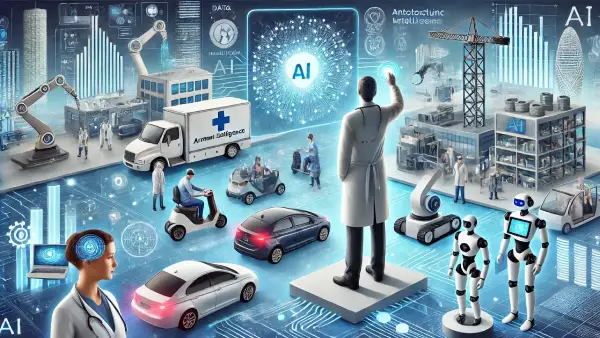
Artificial Intelligence (AI) is no longer something only large tech companies talk about. Today, businesses of all sizes are actively using AI to work smarter, reduce costs, and improve customer experiences. Still, many decision-makers ask a very simple question: How exactly do businesses use artificial intelligence in real life?
This article is written with user intent in mind. Instead of technical explanations, it focuses on practical business use cases, real benefits, and clear examples. You’ll also see how AI strategy consulting and AI automation services play a key role in turning AI ideas into measurable business outcomes.
What Does Artificial Intelligence Mean for Businesses?
In a business context, artificial intelligence refers to software systems that can analyze data, learn from patterns, make decisions, and perform tasks with minimal human intervention. These systems do not replace people; instead, they support teams by handling repetitive work, providing insights, and improving accuracy.
Businesses typically use AI to:
- Automate routine processes
- Analyze large amounts of data
- Predict outcomes and trends
- Improve customer interactions
- Support faster and better decision-making
Why Are Businesses Adopting Artificial Intelligence?
Companies adopt AI for practical reasons, not hype. Common business drivers include:
- Rising operational costs
- Need for faster decision-making
- Growing customer expectations
- Increasing data volumes
- Pressure to stay competitive
With the right approach, AI becomes a tool for efficiency and growth rather than an experimental technology.
Common Ways Businesses Use Artificial Intelligence
1. Customer Support and Service Automation
One of the most popular uses of AI in business is customer support. AI-powered chatbots and virtual assistants handle frequently asked questions, route support tickets, and provide instant responses.
Benefits include:
- Faster response times
- 24/7 customer availability
- Reduced workload for support teams
- Consistent customer experience
Many companies combine chatbots with AI automation services to ensure complex issues are smoothly transferred to human agents when needed.
2. Sales and Marketing Optimization
AI helps sales and marketing teams work more effectively by analyzing customer behavior and predicting buying intent. Businesses use AI for:
- Lead scoring and prioritization
- Personalized marketing campaigns
- Customer segmentation
- Sales forecasting
With guidance from AI strategy consulting, companies can identify which marketing processes benefit most from AI and avoid wasting budget on low-impact tools.
3. Business Process Automation
Traditional automation follows fixed rules. AI-driven automation goes a step further by adapting to changing conditions. Businesses use AI to automate:
- Invoice processing
- Document classification
- Data entry and validation
- Workflow approvals
This is where AI automation services deliver major value by reducing errors, saving time, and improving process efficiency
4. Data Analysis and Decision Support
Businesses generate massive amounts of data, but data alone doesn’t create value. AI systems analyze data to uncover trends, patterns, and risks that humans may miss.
Common use cases include:
- Demand forecasting
- Financial analysis
- Risk assessment
- Performance monitoring
With proper AI strategy consulting, organizations ensure these insights align with business goals instead of creating unused dashboards.
5. Human Resources and Talent Management
AI is increasingly used in HR departments to improve hiring and workforce management. Applications include:
- Resume screening
- Candidate matching
- Employee engagement analysis
- Attrition prediction
These tools help HR teams focus on people rather than paperwork while maintaining fairness and transparency.
6. Supply Chain and Operations
AI improves visibility and efficiency across supply chains. Businesses use AI to:
- Predict demand
- Optimize inventory levels
- Identify bottlenecks
- Improve logistics planning
AI-driven insights help reduce delays, cut costs, and improve reliability across operations.
7. Finance, Fraud, and Risk Management
Financial departments use AI to improve accuracy and security. AI systems can:
- Detect fraudulent transactions
- Automate expense management
- Forecast cash flow
- Monitor compliance
Combining these tools with AI automation services helps finance teams operate faster without compromising control.
The Role of AI Strategy Consulting in Business AI Adoption
Many businesses struggle not because AI doesn’t work, but because they lack a clear plan. AI strategy consulting helps organizations answer critical questions before implementation:
- Which business problems should AI solve?
- What data is required?
- Should we build custom AI or use existing tools?
- How do we measure success?
By aligning AI initiatives with business goals, strategy consulting reduces risk and increases ROI.
How AI Automation Services Turn Strategy into Action
Once the strategy is defined, AI automation services bring it to life. These services focus on:
- Designing intelligent workflows
- Integrating AI with existing systems
- Monitoring performance and outcomes
- Continuously improving automation logic
This combination ensures AI solutions are practical, scalable, and easy to manage.
Benefits Businesses Gain from Using Artificial Intelligence
When implemented correctly, AI delivers clear benefits:
- Increased productivity
- Reduced operational costs
- Faster decision-making
- Improved customer satisfaction
- Better use of data
AI does not replace human judgment; it enhances it.
Common Mistakes Businesses Make with AI
Some businesses struggle with AI adoption due to:
- Starting without a clear strategy
- Poor data quality
- Over-automation without oversight
- Unrealistic expectations
Working with experienced AI consultants and automation providers helps avoid these pitfalls.
The Future of Artificial Intelligence in Business
AI adoption will continue to grow, with trends such as:
- AI agents managing workflows
- Human-in-the-loop AI systems
- Industry-specific AI solutions
- Ethical and responsible AI frameworks
Businesses that start with a strong foundation today will be better prepared for the future.
Conclusion
So, how do businesses use artificial intelligence? They use it to work smarter, make better decisions, and deliver improved experiences. From customer support and marketing to operations and finance, AI is becoming a core business capability.
With the right mix of AI strategy consulting and AI automation services, companies can move beyond experimentation and build AI solutions that deliver real, measurable value. Artificial intelligence is no longer about the future it is about building stronger, more efficient businesses today.