
Have you ever called a customer service line and immediately regretted it? You know the feeling, the endless menus, robotic voices, and awkward pauses that make you want to slam the phone down. In a world where Spoken Experiences are becoming the norm, from smart speakers to in-car assistants, the design of these interactions matters more than ever.
A well-designed spoken experience isn’t just functional; it’s memorable, human, and frictionless. Let’s explore how companies can create voice interactions that people actually enjoy and even look forward to.
Understanding Spoken UX: Why It’s Different
Unlike visual interfaces, spoken interactions are linear. You can’t just show multiple options on a screen; users can only hear one thing at a time.
This limitation is also an opportunity. When done right:
- Clarity wins: Short, simple sentences outperform long explanations.
- Timing matters: Pauses, pacing, and tone guide users naturally.
- Memory is limited: People can’t remember a list of 10 options, so keep it to three or fewer.
Think of it like hosting a conversation rather than delivering a lecture.
Spoken interfaces require empathy: you’re designing for real humans with limited attention, not just systems processing inputs.
Principles of Designing Engaging Spoken Experiences
Creating a voice interaction that people don’t hang up on requires more than just coding.
It’s a delicate mix of psychology, linguistics, and technology. Here’s what matters most:
1. Lead With Context
Users appreciate guidance. Tell them what they can do next instead of leaving them guessing. Example:
“You can say ‘Check balance,’ ‘Make a payment,’ or ‘Talk to an agent.'”
2. Embrace Personality
A little personality goes a long way. Even subtle warmth, humor, or friendliness makes the experience feel human.
Amazon’s Alexa, for instance, occasionally uses light humor to keep users engaged.
3. Design for Error Recovery
Mistakes happen, people mispronounce, background noise interferes, or the system misunderstands. Your experience should anticipate these moments:
- Offer gentle clarifications: “Sorry, I didn’t catch that. Could you say it again?”
- Provide graceful exits or shortcuts so users don’t feel trapped.
4. Use Progressive Disclosure
Avoid overwhelming users with all possible options at once. Introduce new options gradually based on what the user is doing.
Think of it as teaching someone to swim in shallow water before diving into the deep end.
Leveraging AI Without Losing Humanity
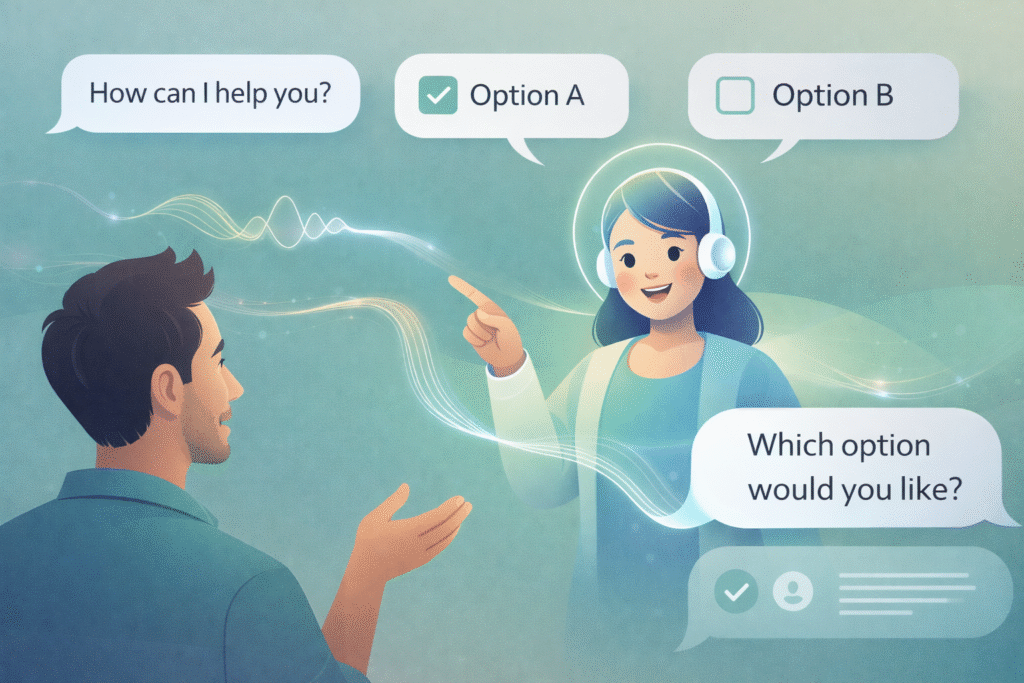
Artificial intelligence has revolutionized how we design spoken experiences.
With advanced natural language processing, systems can understand intent, context, and even emotional cues. But here’s the catch: technology should serve conversation, not dominate it.
- Smart context tracking allows users to jump back and forth in a conversation naturally.
- Sentiment awareness can adjust tone softening responses if frustration is detected.
- Dynamic prompts prevent repetitive or stale interactions.
This is where a Voice AI Agent can make a difference. These systems aren’t just automated responders; they can simulate human-like conversational flow while learning from each interaction.
Practical Tips for Designers
Whether you’re building for customer support, smart devices, or in-app voice features, consider these actionable tips:
- Map the journey: Outline the most likely user paths before writing a single line of dialogue.
- Test with real users: Observe how people naturally talk. Most errors are discovered in human testing, not in theory.
- Keep it brief: People prefer concise prompts; long-winded explanations lead to hang-ups.
- Use visual aids when possible: If combined with a screen, subtle hints can reduce confusion.
- Iterate constantly: Voice interfaces improve with usage data, don’t assume perfection on day one.
The Future of Spoken Experiences
The trajectory is clear: spoken interfaces are becoming ubiquitous. Voice will not just answer questions, it will guide experiences, provide emotional connection, and become a primary interaction mode.
As AI systems advance, designers need to focus on what technology alone can’t replicate: empathy, understanding, and delight.
Remember, the goal isn’t just to answer queries; it’s to make users feel heard and valued. When you achieve that, people won’t just tolerate your voice interface; they’ll actually enjoy it.
FAQs
Q1: What is a Voice AI Agent?
A Voice AI Agent is an AI-powered system that can handle spoken interactions, understand intent, and respond conversationally, often improving with each interaction.
Q2: How do I make a voice interaction more engaging?
Focus on clarity, brevity, personality, and graceful error handling. Test frequently with real users to refine the experience.
Q3: Why are spoken experiences important?
With the rise of smart devices, in-car assistants, and hands-free interactions, voice interfaces are becoming a primary way people engage with technology.
Q4: Can AI really make voice interactions feel human?
Yes, when designed with empathy, context-awareness, and sentiment understanding, AI can create fluid, natural, and even enjoyable conversations.