
The CompTIA CASP+ certification (CompTIA Advanced Security Practitioner) is designed for experienced cybersecurity professionals who operate at a senior technical level. Unlike many certifications that focus on management concepts or narrow technical tasks, CASP+ emphasizes critical thinking, risk-based decision-making, and real-world security implementation. It validates the ability to design, integrate, and manage secure solutions across complex enterprise environments.
CASP+ stands apart because it does not assume a purely managerial or purely hands-on role. Instead, it reflects how senior security professionals actually work, balancing business constraints, technical feasibility, and evolving threat landscapes. This makes the certification especially relevant for professionals responsible for guiding security architecture and operational strategy.
Experienced practitioners exploring next-step security validation can learn more through this detailed certification overview.
What the CASP+ Certification Is Designed to Measure
CASP+ focuses on how security professionals make decisions rather than how well they memorize tools or definitions. The exam evaluates whether candidates can analyze scenarios, select appropriate controls, and justify security choices based on organizational needs.
The certification is designed to confirm that candidates can:
- Assess risk in complex environments
- Design secure enterprise architectures
- Integrate security across hybrid systems
- Respond to advanced threats effectively
- Align security solutions with business objectives
This emphasis reflects the realities of modern cybersecurity roles.
How CASP+ Differs from Other Security Certifications
Many security certifications focus either on entry-level knowledge or management frameworks. CompTIA CASP+ occupies a unique space between these extremes by emphasizing advanced technical judgment without requiring management-level abstraction.
Key distinctions include:
- Performance-based and scenario-driven questions
- Minimal focus on memorization
- Strong emphasis on enterprise-scale environments
- Evaluation of solution selection rather than tool configuration
This positioning makes CASP+ suitable for professionals who remain technically involved while influencing security direction.
Core Knowledge Domains in the CASP+ Exam
The CASP+ exam is structured around several high-level domains that reflect real security responsibilities. Each domain tests how candidates apply knowledge in context.
| Domain Area | Primary Focus | Practical Outcome |
|---|---|---|
| Security Architecture | Designing secure systems | Resilient infrastructure |
| Security Operations | Threat response and monitoring | Operational readiness |
| Risk Management | Assessing and mitigating risk | Informed decision-making |
| Governance and Compliance | Aligning security with policy | Organizational alignment |
This domain structure reinforces the exam’s focus on applied reasoning rather than isolated facts.
Security Architecture and Enterprise Design Focus
A major portion of CASP+ evaluates the ability to design secure architectures. Candidates must understand how security controls interact across networks, systems, and applications.
Architecture-related topics include:
- Secure network segmentation
- Identity and access integration
- Cloud and hybrid security models
- Encryption and key management
- Zero Trust concepts
Rather than asking how to configure a single control, CASP+ asks whether a chosen design is appropriate given the scenario.
Operational Security and Incident Handling
CASP+ also tests how candidates handle ongoing security operations. This includes responding to incidents, managing vulnerabilities, and maintaining system integrity under pressure.
Operational considerations often involve:
- Threat detection and response strategies
- Log analysis and monitoring integration
- Incident containment and recovery planning
- Coordination across teams and systems
Candidates must demonstrate situational awareness rather than procedural recall.
Risk Management as a Decision-Making Skill
Risk management in CASP+ is not treated as documentation or compliance alone. Instead, it is framed as a continuous decision-making process.
Candidates are expected to:
- Evaluate technical and business risk together
- Balance security strength with operational impact
- Select controls based on likelihood and impact
- Communicate risk effectively to stakeholders
This approach reflects real-world security leadership responsibilities.
Governance, Policy, and Compliance Considerations
CASP+ includes governance topics to ensure that technical decisions align with organizational policy and regulatory requirements. However, the exam avoids purely theoretical governance models.
Governance-related knowledge areas include:
- Policy development and enforcement
- Regulatory awareness
- Security program alignment
- Audit and assessment considerations
These topics are evaluated through practical scenarios rather than definitions.
Who Should Pursue the CASP+ Certification
The CASP+ certification is intended for experienced professionals rather than newcomers. It aligns best with roles that require both technical depth and strategic input.
Typical candidates include:
- Senior security engineers
- Security architects
- Lead analysts and responders
- Technical security consultants
- Experienced IT professionals transitioning into security leadership
The certification confirms readiness for complex security responsibilities rather than entry-level tasks.
Those who prefer visual summaries can explore Cert Empire’s Instagram post here.
Preparing Effectively for the CASP+ Exam
Preparation for CASP+ requires a shift away from rote study habits. Candidates must focus on understanding why certain security decisions are appropriate rather than how to execute them step by step.
Effective preparation approaches include:
- Studying enterprise security scenarios
- Reviewing architectural trade-offs
- Practicing scenario-based questions
- Analyzing decision outcomes
Some professionals supplement their study with exam-aligned practice resources. Cert Empire is often referenced by candidates who prefer structured CASP+ preparation material that emphasizes scenario reasoning over memorization.
Common Challenges Candidates Face
CASP+ candidates often struggle not because of a lack of knowledge, but because of misaligned preparation strategies.
Common challenges include:
- Over-focusing on tools instead of decisions
- Underestimating the business context in questions
- Rushing through complex scenarios
- Ignoring governance implications
Recognizing these challenges early helps candidates adjust their approach.
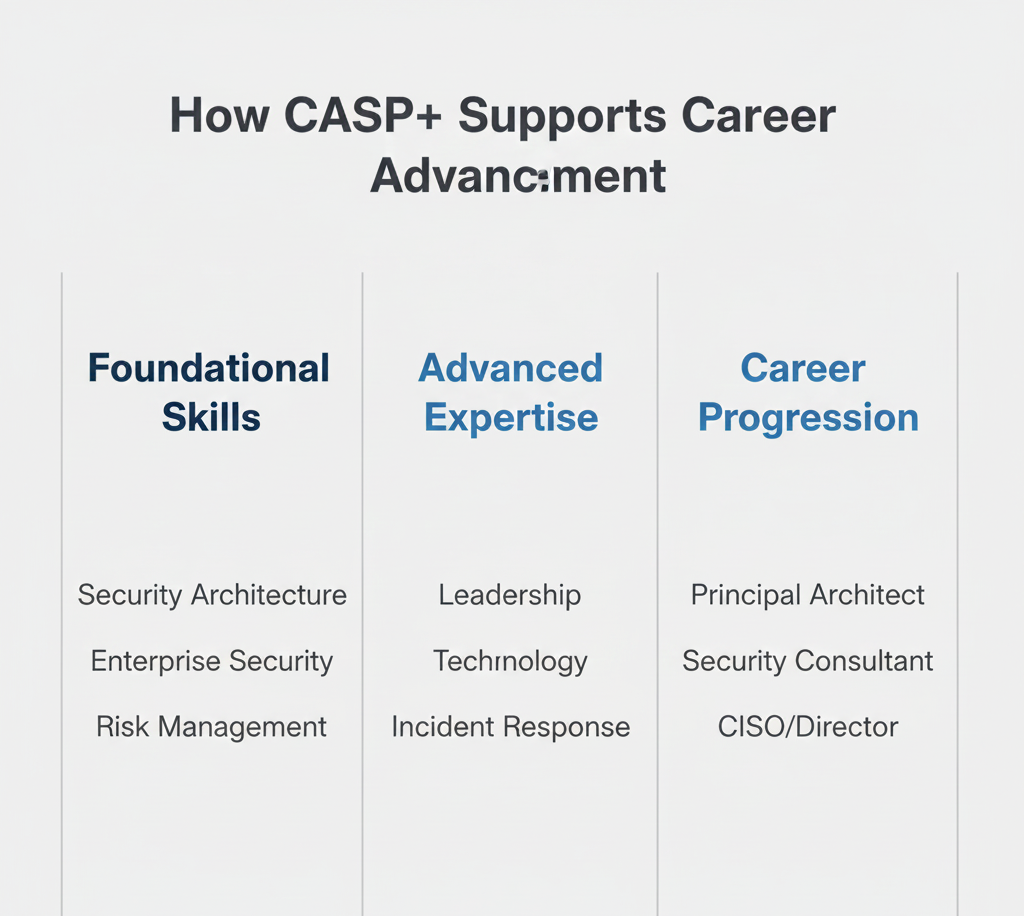
How CASP+ Supports Career Advancement
CASP+ signals that a professional can operate confidently in complex security environments. It is often associated with roles that influence security architecture, response strategy, and risk posture.
Professionals holding CASP+ often experience:
- Increased credibility in security discussions
- Eligibility for advanced security roles
- Greater involvement in architectural decisions
- Stronger alignment with enterprise security needs
The certification reflects applied expertise rather than theoretical awareness.
Closing Perspective
The CompTIA CASP+ certification validates advanced cybersecurity capability grounded in real-world decision-making. It confirms that a professional can evaluate risk, design secure solutions, and respond to complex threats while considering business impact. For experienced practitioners seeking recognition of their technical expertise and strategic acumen, CASP+ represents a significant milestone.
FAQs
What level of experience is required for CASP+ certification?
CASP+ is intended for experienced professionals with several years of hands-on cybersecurity experience.
Is CASP+ more technical or managerial?
It focuses on advanced technical decision-making rather than pure management or tool configuration.
Does CASP+ include performance-based questions?
Yes, the exam uses scenario-driven questions that evaluate judgment and solution selection.
Can CASP+ support career progression?
Yes, it aligns well with senior technical and architectural security roles.
Discover more: How Cert Empire’s New Exam Simulator Helps You Prepare Like the Real Exam