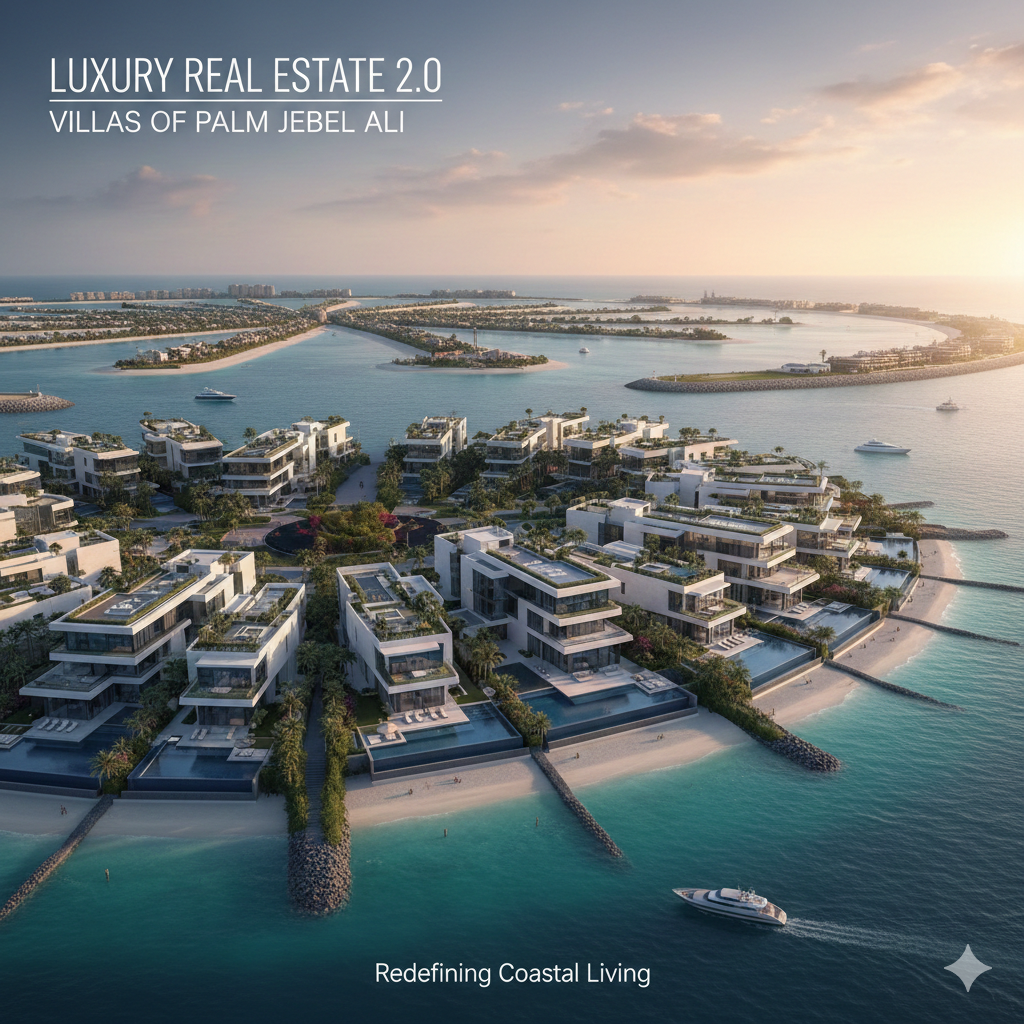
The metamorphosis of the Dubai coastline represents a generational achievement in civil engineering and high-end urban planning. The emergence of the palm jebel ali project as a focal point of the Dubai 2040 Urban Master Plan signifies a pivotal transition into what industry experts categorize as Luxury Real Estate. This next-generation development is not merely an expansion of land but a comprehensive reimagining of how ultra-high-net-worth individuals interact with their environment. While the original Palm Jumeirah set the global benchmark for man-made archipelagos in the early 2000s, the palm jebel ali development expands upon that legacy by offering twice the scale, significantly more private beach connectivity, and a structural integration of sustainability and smart city technology that was previously unavailable.
As a premier off plan project in Dubai, palm jebel ali serves as a strategic anchor for the emirate’s southern growth corridor. The project aims to add 110 kilometers of coastline to the city, creating a unique micro-economy that blends residential exclusivity with world-class hospitality. For the modern investor looking to buy off plan property in Dubai, the project represents a rare alignment of government-backed stability, first-mover pricing advantages, and a vision for future-ready infrastructure. The following analysis explores the intricate details of the villas, the technical specifications of the master plan, and the broader economic implications for the real estate sector in the UAE.
The Strategic Rebirth of Palm Jebel Ali
The historical trajectory of palm jebel ali is a testament to Dubai’s long-term resilience and strategic flexibility. Construction initially commenced in October 2002, with the vision of creating an island 50% larger than Palm Jumeirah. However, the global financial downturn of 2008 necessitated a lengthy hiatus, during which the project remained dormant for nearly fifteen years. During this period, the island existed as a reclaimed landmass, awaiting the necessary market maturity and economic momentum for its next phase.
The announcement of the project’s revival in 2023, under the personal oversight of Sheikh Mohammed bin Rashid Al Maktoum, transformed the site from a legacy project into a futuristic flagship. The revamped master plan aligns with the Dubai Economic Agenda D33, which seeks to double the city’s economy by 2033. This revival is not just a continuation of the old plans but a radical upgrade. The new vision incorporates next-generation luxury standards, smart city IoT integration, and renewable energy solutions that were not technologically viable during the initial design phase.
Comparative Scale and Geographical Significance
Understanding the physical scale of the palm jebel ali project is essential for grasping its market potential. The development spans 13.4 square kilometers of reclaimed land, making it twice the size of Palm Jumeirah. This massive footprint allows for a less dense urban fabric, prioritizing larger plots and wider separation between fronds to enhance the perception of privacy and exclusivity.
| Metric | Palm Jumeirah | Palm Jebel Ali |
| Total Land Area | 61 million sq. ft. | 147 million sq. ft. |
| New Coastline Added | ~70 km | 110 km |
| Beachfront Length | ~50 km | 91 km |
| Number of Fronds | 17 | 16 |
| Residential Capacity | ~80,000 residents | 250,000 residents |
| Distance Between Fronds | 30 – 100 meters | 100 – 400 meters |
The increased distance between the fronds is a critical architectural upgrade. While Palm Jumeirah’s fronds are relatively close to one another, the fronds on palm jebel ali are spaced up to 400 meters apart at the tips. This design choice prevents the “visual clutter” often associated with dense waterfront developments, ensuring that every resident has an expansive, uninterrupted view of the Arabian Gulf.
Architectural Typologies: The Beach and Coral Collections
The residential core of the palm jebel ali villas is divided into two primary collections, each catering to a distinct tier of the luxury market. These collections—the Beach Collection and the Coral Collection—are the result of collaborations between Nakheel and world-renowned architectural firms such as SAOTA, Naga Architects, and LW Design.
The Beach Collection: Refined Coastal Sophistication
The Beach Collection is designed for those seeking a harmonious blend of contemporary aesthetics and functional family living. These villas offer 5 and 6-bedroom configurations with built-up areas starting from approximately 7,300 square feet and extending to over 8,450 square feet. Each villa is meticulously positioned to offer direct beach access and a private swimming pool, emphasizing a seamless indoor-outdoor lifestyle.
- Azure Blue: A 5-bedroom configuration spanning 8,434 square feet, characterized by a layered design and abundant greenery.
- Blue Horizon: A 6-bedroom model that emphasizes street-side and beach-side orientations to maximize natural light.
- Provence and Mediterranean: Styles that draw inspiration from European coastal architecture while integrating modern glass facades.
- Sapphire and Acquamarina: Layouts focused on “blissful beachfront residences” with bespoke options for pool configurations.
Prices for the Beach Collection typically start at AED 18.1 million, making them a competitive entry point for high-tier waterfront real estate.
The Coral Collection: Ultra-Premium Island Mansions
The Coral Collection represents the pinnacle of luxury within the palm jebel ali real estate portfolio. These 7-bedroom mansions are situated on significantly larger plots, offering up to 30% more space than comparable properties on Palm Jumeirah. The built-up areas for these residences range between 11,200 and 12,200 square feet.
- Villa Hibiscus and Coral Living: Designs that utilize saffron, coral, and terracotta palettes to reflect the natural surroundings.
- Red Aurora and Porcelain Rose: Modernist interpretations featuring double-height living rooms and expansive terraces.
- Cranberry Sky and Terracotta: Mansions that include specialized amenities such as private gyms, libraries, and separate guard houses.
- Redwood and Ruby Sunset: High-spec upgrades that combine stone, wood, and glass to create a tactile and warm interior environment.
These mansions start at approximately AED 26.8 million to AED 30 million, reflecting their status as trophy assets for UHNWIs.
Infrastructure and Smart City Engineering
A significant differentiator for this off plan project in UAE is the level of investment in primary infrastructure. Nakheel has awarded contracts worth over Dhs 750 million to major civil and marine contractors to ensure the island’s connectivity is world-class from day one. The development is not just about the villas; it is about building a future-proof urban ecosystem.
Power, Water, and Waste Management
The Dubai Electricity and Water Authority (DEWA) is deeply integrated into the project’s timeline. In October 2024, a Dhs 270 million contract was awarded for the construction of two major 132kV substations. These substations are timed to coincide with the delivery of the first villas, ensuring that residents have reliable, sustainable power.
Furthermore, the project utilizes district cooling systems and intelligent water management to reduce the environmental footprint of the community. Unlike the original Palm Jumeirah, which relied on more traditional utility models, palm jebel ali is designed with “net-zero-ready” infrastructure, allowing for solar panel integration on a massive scale.
Connectivity and Transport Architecture
One of the most frequent criticisms of artificial islands is their isolation. The palm jebel ali project addresses this through a robust transport strategy. A new 6-kilometer public access road will connect the island directly to Sheikh Zayed Road (E11). This connection is vital for the island’s integration into the wider city and its accessibility to major business hubs.
| Hub | Distance/Time | Strategic Benefit |
| Al Maktoum International Airport | 15 – 20 minutes | Proximity to the world’s future largest airport hub |
| Dubai Marina | 25 minutes | Immediate access to established lifestyle and dining zones |
| Downtown Dubai | 30 – 45 minutes | Connectivity to the city’s financial and commercial core |
| Jebel Ali Free Zone (JAFZA) | 8 – 10 km | Proximity to one of the world’s largest logistics hubs |
| Abu Dhabi Border | ~20 minutes | Strategic positioning for inter-emirate commuters |
Beyond road transport, the island is designed to accommodate future public transit integrations and electric vehicle (EV) charging networks, supporting the emirate’s push toward sustainable mobility.
Investment Dynamics: The Economics of Off-Plan Acquisitions
Investing in a project of this magnitude requires a deep understanding of market cycles and developer reliability. The return of Nakheel as a member of Dubai Holding Real Estate provides a level of institutional backing that mitigates traditional off-plan risks. For investors who buy off plan property in Dubai, the current entry points on Palm Jebel Ali offer a compelling appreciation arc.
Payment Plan Analysis
The developer offers an 80/20 payment plan, which has become a standard for a premium off plan project in Dubai. This structure requires an initial 20% down payment, followed by installments totaling 60% during the construction phase, with the final 20% due upon handover in Q4 2027 or Q4 2028.
| Phase | Payment Percentage | Milestone |
| Booking Fee | 20% | Immediate Reservation |
| Installments 1-3 | 20% | Spread across 2025 |
| Installments 4-9 | 40% | Spread across 2026-2027 |
| Completion | 20% | Final Handover (Q4 2028) |
This staged entry allows investors to capture capital appreciation as construction milestones are met. Historical data from similar prime projects in Dubai suggests that property values can increase by 20% to 30% between the launch and the final delivery of the asset.
Capital Appreciation and Market Maturation
The market for palm jebel ali real estate is fueled by the scarcity of prime waterfront land in Dubai. As of 2025, the demand for ultra-luxury villas and plots continues to outpace supply, with quarterly price growth in the prime segment remaining strong at 15.8%. Unlike the apartment segment, which faces a larger supply pipeline, ultra-premium villas on the Palm are considered “trophy assets” that are less sensitive to broader market corrections.
Furthermore, the integration of the project with the Dubai 2040 Urban Master Plan ensures that the infrastructure surrounding the island—such as the Etihad Rail and the expansion of the Al Maktoum Airport—will continue to drive long-term value. This makes the property for sale in Dubai at this location particularly attractive for long-term wealth preservation.
Professional Standards: The Role of a Real Estate Company in Dubai
Navigating a multi-million-dirham transaction on Palm Jebel Ali is a complex process that involves more than just selecting a villa. A specialized real estate company in Dubai provides the necessary due diligence, market analytics, and regulatory compliance to protect the buyer’s interests.
Property Valuation in Dubai: RICS and RERA Standards
For a luxury off plan project in Dubai, property valuation in dubai is a critical step, especially for buyers requiring mortgage financing. Valuations are conducted according to the RICS Valuation – Global Standards (the “Red Book”) to ensure transparency and consistency.
Valuers focus on several key drivers of value for palm jebel ali villas:
- Frond Position: Properties located at the tip of the fronds command a premium due to wider views and lower density.
- Plot Size: The larger plots on Palm Jebel Ali (averaging 21,000 to 28,000 sq. ft.) are a primary driver of value compared to smaller, older plots on Palm Jumeirah.
- Brand and Architect: Villas designed by prestige firms like SAOTA or those featuring “Bespoke Edition” upgrades achieve higher per-square-foot rates.
- Infrastructure Progress: Valuations for off-plan assets are tied directly to construction benchmarks verified by RERA.
Navigating the Golden Visa and Regulatory Framework
The Dubai government has introduced several initiatives to foster a stable investment environment. The 10-year Golden Visa program, available to individuals investing AED 2 million or more in property, has significantly boosted demand from international families and UHNWIs. A reputable real estate company in Dubai assists investors in navigating these legal frameworks, ensuring that their investment is not only profitable but also provides long-term residency benefits.
The Friday Mosque and Retail Center
Architectural excellence is not reserved for the villas alone. Nakheel has launched plans for a major Friday mosque designed by the world-renowned firm Skidmore, Owings & Merrill (SOM). Located at the heart of the island, the mosque reimagines traditional Islamic architecture with sculptural forms that invite light and reflection, creating a serene space for up to 1,000 worshippers.
Adjacent to the religious core is a 9,000-square-meter retail center designed to serve the daily needs of residents. The broader retail landscape of the island will include “The Spine,” a district dedicated to lifestyle shopping, celebrity-chef-helmed restaurants, and high-end cafes.
Education and Wellness
The development includes sites for specialized clinics and wellness centers, reducing the need for residents to travel to the mainland for medical care. Schools such as Dove Green Private School and Emaar South School are located in the nearby southern corridor, providing immediate options for families while on-island schools are being completed.
The “Spine” also features wellness resorts, sports clubs, and 146 hectares dedicated to “active living”. This focus on well-being is a core component of the Luxury Real Estate 2.0 paradigm, where the environment is designed to promote health as much as it is to provide luxury.
Sustainability: A Modern Imperative
In the current global real estate market, sustainability is no longer optional. The palm jebel ali project is a model for eco-conscious waterfront development. The island’s utilities, road layouts, and district cooling systems are optimized for resource conservation.
Renewable Energy and Marine Protection
Nakheel has committed to integrating renewable energy into public facilities. Solar panels are planned for street lighting and community centers, while villa designs are “net-zero-ready,” allowing homeowners to integrate solar power seamlessly into their residences.
Protecting the surrounding marine ecosystem is a primary focus during construction. The project incorporates erosion-resistant shorelines, native plant species for landscaping, and eco-conscious embankments to minimize tidal impact. These measures ensure that the island is not only a beautiful place to live but also a durable and environmentally responsible one.
Smart Mobility Solutions
The island’s layout encourages low-impact movement. Extensive pedestrian walkways, shaded cycling routes, and shoreline paths are integrated from the initial planning stages. This “20-minute city” concept allows residents to access the majority of their daily needs within a short walk or cycle, reducing car dependency and supporting the city’s broader sustainability goals.
The Future Anchor: “The Crown” and Casino Rumors
The “Crown” district (Crescent C) is the most anticipated social and entertainment hub on the island. Designed to be a “celebratory” and “grand” district, it will host iconic public spaces and a vibrant town center.
One of the most significant rumors surrounding the project is that The Crown will feature Dubai’s first integrated casino resort. While these reports remain unconfirmed by official government statements, the Master Plan for The Crown includes provisions for large resort hotels, cultural destinations, and iconic towers with 360-degree panoramic views. The completion of this district is targeted for 2032, positioning it as a long-term driver of tourism and hospitality revenue for the island.
Strategic Comparison: Palm Jumeirah vs. Palm Jebel Ali
For the investor or prospective resident, choosing between the two Palms depends on their specific goals. Palm Jumeirah offers the security of a mature, proven market with immediate occupancy. Palm Jebel Ali, however, offers the potential for significantly higher capital appreciation and the chance to own a more modern, spacious asset.
| Feature | Palm Jumeirah (The Established Choice) | Palm Jebel Ali (The Future Flagship) |
| Development Phase | Fully Operational | Active Construction (Handovers 2027-28) |
| Lifestyle | Vibrant, Urban, Bustling | Serene, Wellness-Oriented, Family-Centric |
| Plot Sizes | Compact, High Density | 30% Larger, Low Density |
| Connectivity | Close to Downtown/Marina | Close to Al Maktoum Airport/Abu Dhabi |
| Investment Potential | Stable Yields, Resale Strength | Growth Opportunity, First-Mover Pricing |
Palm Jumeirah is suited for those who value proximity to the traditional heart of Dubai and need a “ready” property. Palm Jebel Ali is the choice for visionaries who want to be part of the city’s next decade of growth and who prioritize space, nature, and modern innovation.
Conclusion: A Landmark in Global Coastal Development
The palm jebel ali project is more than just a real estate venture; it is an architectural and economic statement. By successfully reviving and reimagining this iconic archipelago, Dubai has demonstrated its commitment to the 2040 Urban Master Plan and its ability to deliver infrastructure on an unprecedented scale. For the global elite, the palm jebel ali villas represent the ultimate expression of waterfront living—one that combines the prestige of the “Palm” brand with the sustainability and technology of the 21st century.
As a strategic off plan project in uae, it offers a secure and lucrative opportunity for those who understand the value of early-stage investment in prime land. With government backing, a robust infrastructure pipeline, and the expertise of Nakheel, Palm Jebel Ali is set to become the premier coastal destination of the Middle East, influencing global standards for waterfront development for decades to come.
Frequently Asked Questions
1. What is the size difference between Palm Jumeirah and Palm Jebel Ali?
Palm Jebel Ali is designed to be approximately twice the size of Palm Jumeirah.3 It covers an area of 13.4 square kilometers (147 million square feet) and adds 110 kilometers of new coastline to the emirate of Dubai.
2. When will the first villas on Palm Jebel Ali be handed over?
Initial residential property handovers for the Beach and Coral collections are anticipated to take place in late 2027, with the majority of the first phase being completed by Q4 2028. Infrastructure works such as roads and utilities are scheduled for completion by the end of 2026.
3. What are the starting prices for property on Palm Jebel Ali?
As of early 2025, starting prices for the Beach Collection (5-6 bedroom villas) are approximately AED 18.1 million. The more exclusive Coral Collection (7-bedroom mansions) begins at approximately AED 26.8 million to AED 30 million.
4. Are there apartments available on Palm Jebel Ali?
Yes, the master plan includes “Palm Central Private Residences,” which are mid-rise buildings located along the island’s central spine between Fronds M and N. These feature 1 to 5-bedroom apartments and signature penthouses with panoramic views.
5. What are the key amenities planned for the island?
The island will feature over 80 luxury hotels and resorts, multiple marinas, a “Luxury Lifestyle Mall,” and “The Crown” entertainment hub. It will also include a Friday mosque designed by SOM, championship golf courses, wellness centers, and specialized schools and healthcare clinics.