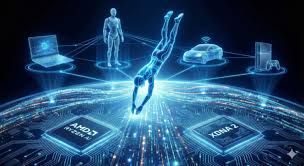
Artificial intelligence in 2026 is not just smarter — it’s faster, leaner, and dramatically more hardware-aware. While algorithms grab headlines, the true competitive edge lies beneath the surface: advanced processors engineered specifically for AI workloads. The race is no longer about who builds the biggest model, but who powers it most efficiently.
In this comprehensive guide, we explore the Best AI Hardware & Processors for Computing in 2026, uncovering the technologies redefining performance, scalability, and energy efficiency.
Why AI Hardware Matters More Than Ever
AI systems depend heavily on matrix multiplications and tensor operations. As models grow larger, computational demand doesn’t increase linearly — it scales aggressively. A simplified way to understand this rising demand is through quadratic growth:
y=ax2y=ax^2y=ax2
a=a =a=
-10-8-6-4-224681020406080100
This illustrates how processing requirements can surge as datasets and parameters expand. That’s why general-purpose CPUs are no longer sufficient for high-performance AI computing.
NVIDIA GPUs: Setting the Performance Benchmark
NVIDIA remains a dominant force in AI acceleration. Its GPU architectures are specifically optimized for deep learning, particularly transformer-based models used in generative AI and advanced analytics.
What Makes NVIDIA GPUs Stand Out in 2026?
- High-density tensor cores for parallel computation
- Advanced high-bandwidth memory systems
- Scalable multi-GPU configurations
- Mature AI software ecosystem
From startups training neural networks to enterprises running large-scale inference clusters, NVIDIA continues to power a significant portion of global AI workloads.
Google TPUs: Cloud-Optimized AI Processing
Google designed Tensor Processing Units (TPUs) to address AI workloads at scale. Unlike general GPUs, TPUs are purpose-built for tensor operations, making them highly efficient for training large models.
Key Benefits of TPUs in 2026
- Optimized matrix computation pipelines
- Energy-efficient model training
- Seamless integration with cloud-native platforms
- Reduced latency for distributed AI systems
TPUs are especially advantageous for organizations operating in large cloud ecosystems, where AI workloads demand scalable infrastructure.
AMD AI Accelerators: Power Meets Affordability
Advanced Micro Devices has emerged as a strong competitor in AI hardware. Its accelerators offer impressive performance with competitive pricing, making AI infrastructure more accessible.
Why Businesses Choose AMD in 2026
- Advanced chiplet-based architecture
- Strong memory bandwidth capabilities
- Attractive performance-to-cost ratio
- Growing AI development ecosystem
AMD’s hardware is increasingly popular among enterprises seeking high-performance AI computing without vendor lock-in concerns.
Apple Silicon and the Rise of Edge AI
AI processing is shifting toward the edge — from data centers to personal devices. Apple Inc. integrates neural engines directly into its silicon, enabling on-device AI processing.
Advantages of Edge AI Hardware
- Real-time decision-making
- Enhanced user privacy
- Lower reliance on cloud connectivity
- Reduced latency for interactive applications
Edge AI processors power applications in smartphones, wearables, smart cameras, and IoT systems. In 2026, intelligence is increasingly embedded directly into everyday devices.
Custom AI Chips: Enterprise-Level Innovation
Beyond major chip manufacturers, many hyperscale companies and enterprises are developing custom AI ASICs (Application-Specific Integrated Circuits). These chips are tailored to specific workloads, maximizing performance efficiency.
Benefits of Custom AI Processors
- Optimized architecture for proprietary models
- Lower long-term infrastructure costs
- Enhanced energy efficiency
- Strategic technological independence
Custom silicon allows organizations to align hardware directly with their AI pipelines, improving both performance and sustainability.
Energy Efficiency: The Silent Differentiator
AI workloads consume substantial energy, making power efficiency a crucial metric. In 2026, performance per watt is as important as raw speed.
Innovations driving energy efficiency include:
- 3D chip stacking
- Advanced cooling solutions
- Optimized instruction sets
- AI-specific microarchitectures
Companies that balance performance with sustainability are better positioned for long-term AI scalability.
Cloud vs Edge: A Hybrid AI Future
The best AI hardware strategies combine cloud-scale training with edge-based inference.
Cloud Infrastructure
- Ideal for training large foundation models
- Highly scalable and centralized
- Supports distributed AI clusters
Edge Infrastructure
- Best for real-time applications
- Enhances privacy and responsiveness
- Reduces bandwidth costs
A hybrid model allows businesses to leverage the strengths of both environments.
Conclusion: The Future Is Hardware-Driven Intelligence
The Best AI Hardware & Processors for Computing in 2026 are transforming how artificial intelligence operates across industries. From powerful GPUs and TPUs in data centers to compact neural processors embedded in consumer devices, the hardware landscape is evolving rapidly.